Is Cortisol Bad? Your Stress Hormone in Perimenopause

Brief Overview
Cortisol is not the enemy. It is the hormone that gets you out of bed, steadies your blood sugar and keeps inflammation in check. Problems start when its daily rhythm is disrupted by chronic stress, poor sleep, blood sugar swings, over-training or too much caffeine, which is more common in perimenopause as progesterone declines. The signs: wired but tired, energy crashes, waking between 2 am and 4 am, weight around your middle, and mood changes. The goal is rhythm, not suppression: morning light, a protein-rich breakfast, caffeine after food, sensible movement, daily calm moments and protected sleep. Where it will change the plan, a DUTCH test can map your cortisol across the day.
You are wide awake at 3 am again. Your alarm goes off and you feel like you have not slept. By mid-afternoon you are running on coffee and willpower, and by the evening you are exhausted but somehow too wired to wind down.
Somewhere along the way you have read that cortisol is to blame, and that the answer is to "lower" it.
In my experience, that is the wrong target. Let me explain what cortisol is actually doing, why the rhythm matters far more than the number, and what genuinely helps.
What is cortisol, and what is it supposed to do?
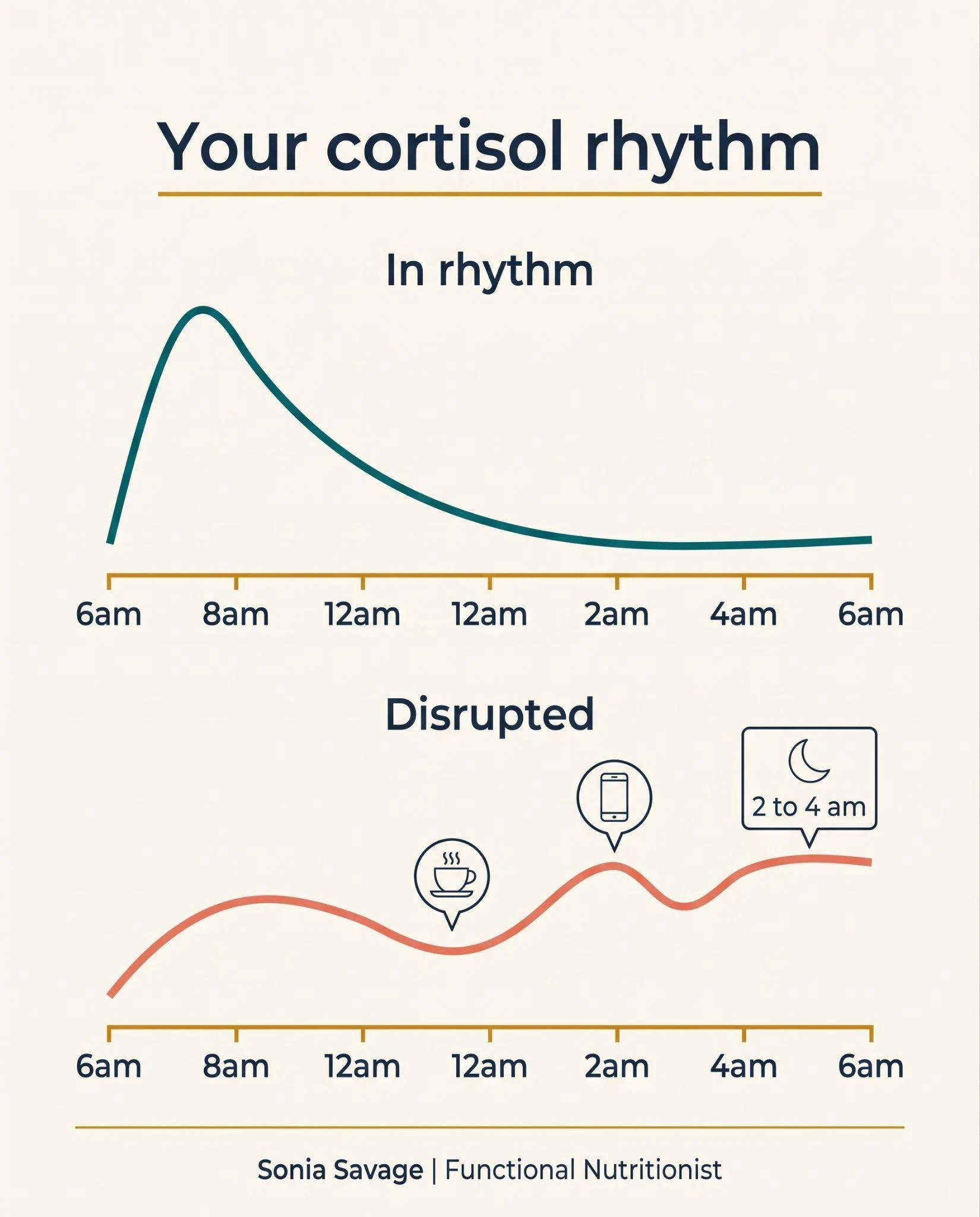
Cortisol is your body's main stress hormone, made by the adrenal glands. It follows a daily rhythm: highest in the morning to wake you, gently falling through the day, and lowest at night so you can sleep.
Cortisol gets called "the stress hormone", and that label is where the trouble starts. Yes, it rises when you are under pressure. But its everyday job is far bigger than stress.
Think of it as your body's daily conductor. It should peak within the first hour or so of waking (this is called the cortisol awakening response), giving you the energy and focus to start the day. From there it should decline steadily, so that by evening it is low enough for melatonin to rise and for deep, restorative sleep to happen.
That morning-high, evening-low pattern is what a healthy cortisol rhythm looks like. When I talk about "cortisol balance" with clients, this rhythm is what I mean. Not more, not less. In the right amount, at the right time of day.
Why cortisol is your friend when it is in rhythm
When cortisol follows its natural rhythm, it supports energy, focus, stable blood sugar, a healthy metabolism and a calm inflammatory response. It also helps you handle short-term stress and recover from it.
In the right rhythm, cortisol is doing a lot of quiet, helpful work:
It gets you out of bed. That morning rise is what lifts you into the day with clear-headed energy.
It supports your metabolism. Cortisol helps release stored glucose so you have fuel, and it works closely with insulin to keep blood sugar steady.
It keeps inflammation in check. Cortisol is one of your body's own anti-inflammatory signals, which is one reason chronic stress and chronic inflammation so often travel together.
It helps you rise to a challenge. A short burst of cortisol sharpens focus and gives you the energy to deal with what is in front of you, then settles again.
It supports your goals. Whether that is a training session, a work deadline or getting through a hard week, healthy cortisol is what gives you the capacity to do it.
So the aim is never to "get rid of" cortisol. A person with too little cortisol feels flat, foggy and unable to cope. What we want is the rhythm working as designed.
So why does cortisol get such a bad name?
The problem is not cortisol itself. It is chronic stress and a disrupted rhythm. When the demands on your body are constant, cortisol stops rising and falling cleanly, and that is when the familiar symptoms appear.
Your stress response was designed for short bursts: deal with the threat, recover, return to baseline. Modern life rarely offers the recovery part.
In clinic, the drivers I see most often are poor or broken sleep, ongoing emotional stress, blood sugar swings from skipped meals or a high-sugar diet, over-training (especially high-intensity exercise on top of an already stressed system), too much caffeine, particularly on an empty stomach, and underlying inflammation from gut issues, food reactions or environmental exposures such as mould.
Each of these is a demand. Stack enough of them together, day after day, and the rhythm flattens or flips. Cortisol may stay elevated into the evening when it should be low, or fail to rise properly in the morning when you need it most.
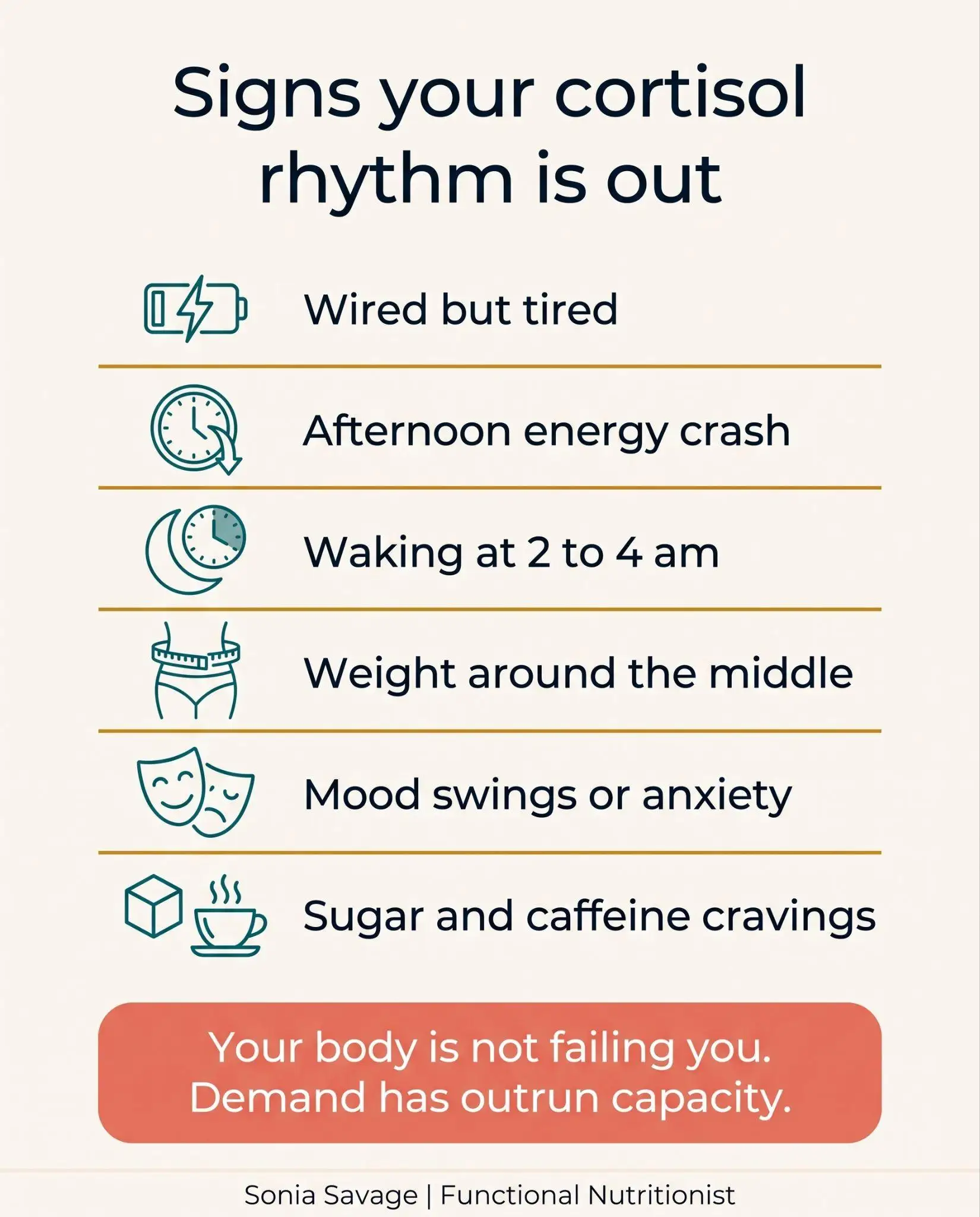
The signs that your rhythm is out are usually a familiar cluster:
Feeling "wired but tired": exhausted, yet unable to switch off
Energy crashes, particularly mid-afternoon
Poor sleep, and especially waking between 2 am and 4 am
Weight gathering around your middle, even when your eating has not changed
Mood swings, irritability, low mood or anxiety
Sugar and caffeine cravings to get through the day
If several of these are ringing true, your body is not failing you. It is telling you that demand has outrun capacity.
Why does cortisol matter more in perimenopause?
As progesterone declines in perimenopause, you lose one of your body's natural calming buffers, so the same level of stress lands harder. Cortisol then interacts with blood sugar, sleep and oestrogen in ways that make 3 am waking, midsection weight and mood changes more common.
Many of the women I see for cortisol-type symptoms are in their forties and early fifties, and that is no coincidence.
For years, your hormones quietly buffered stress and inflammation behind the scenes. Progesterone in particular has a calming, sleep-supporting effect on the nervous system. It is often one of the first hormones to decline in perimenopause, and as that buffer lifts, issues that were bubbling under the surface start to show. A stressful week that you once shrugged off now costs you three nights of sleep.
Cortisol and your sex hormones are made from shared raw materials and regulated by the same control centre in the brain. When the stress response is running hot, it can pull resources away from hormone production and unsettle the whole system. This is one reason women often notice their cycle, mood and sleep all shift together during a stressful season.
Then there is blood sugar. Cortisol raises blood glucose, and as insulin sensitivity tends to drop through the menopause transition, that combination is a big part of why weight settles around the middle in a way it never did before.
So yes, cortisol is part of the picture in perimenopause. But it is only one part. When someone tells you it is "just stress" or "just hormones", they are looking at a single piece of a much bigger puzzle. Gut health, nutrient status, thyroid, blood sugar and inflammation are all in the mix, and everything is connected.
Is "adrenal fatigue" a real thing?
Adrenal fatigue is not a recognised medical diagnosis, and your adrenal glands do not simply "wear out". But the experience people describe with that phrase is very real: it reflects a long-standing mismatch between the demands on your body and its capacity to recover.
I want to be honest about this one, because it comes up a lot.
The term "adrenal fatigue" is not supported as a diagnosis, and I do not use it clinically. What I do see, every week, is the pattern people are trying to describe when they say it: months or years of running on empty, sleep that never restores, and a stress response that no longer rises and falls the way it should.
A more accurate way to think about it is dysregulation of the stress response system (the brain-adrenal axis) rather than exhausted glands. That distinction matters, because it changes what we do about it. We are not trying to "boost" tired adrenals. We are restoring rhythm and reducing the load.
Dealing With This Yourself?
Wired but tired, waking at 3 am, weight creeping onto your middle and bloods that keep coming back "normal". This is exactly the kind of puzzle I work through with women every week. If you would like someone to look at the whole picture, an initial consultation is the place to start.
Book an Initial Consultation →
How do you know whether your cortisol rhythm is out?
Your symptoms and your daily pattern tell most of the story. Where a result will genuinely change the plan, a DUTCH test can map your cortisol across the day, and bloods reviewed against optimal ranges show what else is contributing.
You do not always need a test to know something is off. A thorough clinical history usually gets us most of the way: when did the exhaustion start, what was happening in your life at the time, how do you feel on waking, when do you crash, and what does your night look like?
Where testing will change what we do, I use the DUTCH test. Rather than a single snapshot, it maps your cortisol pattern across the day, from the morning rise to the evening low, alongside how you produce and clear oestrogen, progesterone, and androgens. For a woman in perimenopause, seeing the stress and sex hormone picture side by side is often the moment the puzzle makes sense.
I also review your bloods against optimal ranges rather than the standard reference range, and I look at things that are often never checked: blood sugar handling, iron, B12, vitamin D, thyroid antibodies, and inflammatory markers. A cortisol problem rarely travels alone.
How do you support a healthy cortisol rhythm naturally?
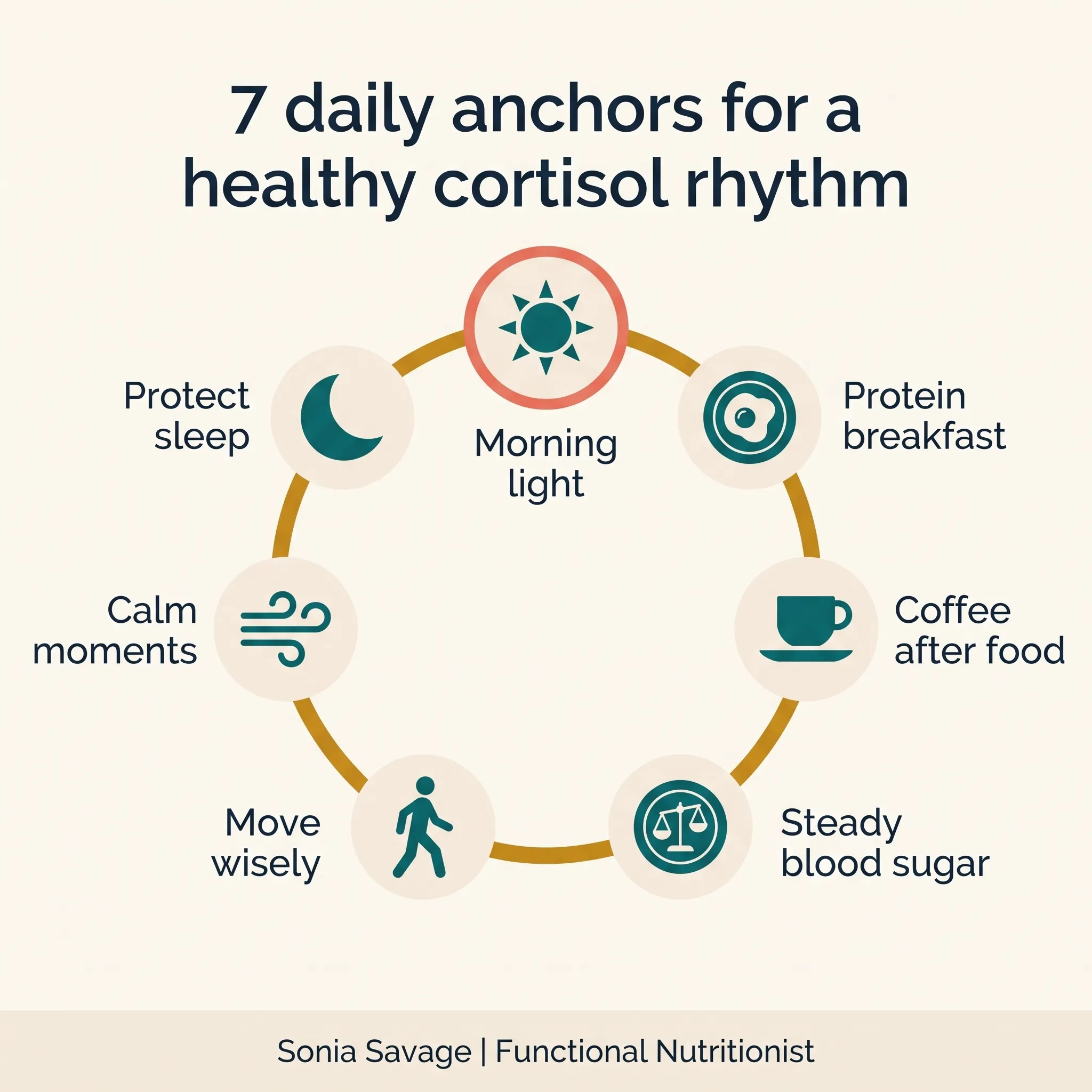
Anchor your day with morning light, eat a protein-rich breakfast before caffeine, keep blood sugar steady, match exercise to your capacity, build in short daily calm moments, and protect your sleep with a consistent wind-down. Small, repeated signals of safety are what reset the rhythm.
This is the part I care about most, because it is the part you can act on. None of it is extreme. The aim is to give your body enough consistent signals that it is safe to come down from high alert. Start here this week:
Get morning light. Step outside within 30 to 60 minutes of waking, without sunglasses, even on a cloudy day. Morning light anchors your circadian rhythm, which is what tells cortisol when to rise and, just as importantly, when to fall.
Eat a protein-rich breakfast. Aim for a proper serve of protein (eggs, Greek yoghurt, fish, leftover meat, tofu or a quality protein smoothie) with some healthy fat and fibre. Stable blood sugar in the morning means fewer cortisol spikes and crashes later in the day.
Have your coffee after food, not before. Caffeine on an empty stomach pushes cortisol higher at the point where it is already peaking. Nourish first, then enjoy your coffee, and try to keep it to the morning.
Keep blood sugar steady through the day. Regular meals built on protein, vegetables, good fats and slow carbohydrates, in the lower-carbohydrate, Mediterranean-style way of eating I use in clinic. Skipping lunch to "be good" is a stress signal your body will answer with cortisol.
Exercise wisely. Movement is medicine, but the dose matters. If you are already depleted, daily high-intensity sessions add to the load. Walking, strength training, yoga and Pilates give you the benefits without the cost. Save the hard sessions for when you have slept well.
Build in calm moments. Five to ten minutes of slow breathing, a walk without your phone, or simply sitting still with a cup of tea. Slow, deep breathing sends a direct signal of safety to your nervous system and helps shift it out of fight-or-flight.
Protect your sleep like it is an appointment. A consistent bedtime, dim lights in the last hour, and the phone out of the bedroom. Late-night scrolling keeps both your brain and your cortisol switched on when they should be winding down.
You do not have to do all seven perfectly. Pick two, do them every day for a fortnight, and notice what changes. That is how I work with clients: baby steps, consistently, rather than an overwhelming list.
What about supplements for stress and sleep?
Certain nutrients, herbs and amino acids can support the nervous system and sleep, but they work best on top of the daily rhythm work, not instead of it, and they should be individualised to you rather than bought off the internet.
I am often asked about magnesium, adaptogenic herbs and calming amino acids, and there is a place for them. Magnesium in particular is a nutrient many of my clients are low in, and it plays a role in relaxation, sleep and nervous system regulation.
But I want to be straight with you: no supplement can outrun a 4 am scroll session and skipped meals. Supplements are the top layer, not the foundation.
In clinic, I prescribe targeted supplementation after reviewing your history, your bloods, and, where relevant, your genetics, and it is dispensed through a practitioner-only dispensary so you get the right form at the right dose. What works well for one woman can be the wrong choice for another, particularly where thyroid, autoimmune, or histamine issues are in the picture.
The reframe: work with cortisol, not against it
Cortisol is not something to fear or suppress. It is something to understand and work with.
When your rhythm is supported, you feel energised in the morning, focused through the day, able to wind down at night, and resilient enough to handle what life throws at you. That is what healthy cortisol looks like, and it is entirely possible in perimenopause.
If you are feeling exhausted, wired, overwhelmed or simply not like yourself, it is not because your body is failing you. It is often a sign of stress overload and a disrupted rhythm, and a gentle invitation to support your body differently.
Frequently asked questions
Can a functional nutritionist help with cortisol and perimenopause symptoms?
Yes. This is central to my practice. In an initial consultation, I take a thorough history, review your bloods against optimal ranges, and, where it will change the plan, use a DUTCH test to see your cortisol and sex hormone pattern together. You leave with a clear, staged roadmap covering food, sleep, movement, stress and targeted support. You can book online, or start with a free 15-minute call if you have questions first.
Can cortisol be tested?
Yes. A single morning blood test gives a snapshot, but it does not show the rhythm. The DUTCH test measures cortisol at several points across the day, which is what tells us whether your pattern is high, low, flat or flipped. I only recommend it where the result will genuinely change what we do.
Is cortisol why I wake up at 3 am in perimenopause?
It is often part of it. A blood sugar dip overnight can trigger a cortisol rise that wakes you, and declining progesterone removes a natural sleep buffer. Steadier blood sugar through the day, a protein-rich dinner, less alcohol and a consistent wind-down routine are the first things I work on with clients who wake in the early hours.
Does cortisol cause belly fat in perimenopause?
Cortisol is one contributor. It raises blood glucose, and as insulin sensitivity tends to decline through the menopause transition, the combination encourages fat storage around the middle. Restoring cortisol rhythm, stabilising blood sugar and building muscle through strength training are the levers I focus on, rather than more restriction.
Is adrenal fatigue real?
"Adrenal fatigue" is not a recognised medical diagnosis, and the adrenal glands do not simply wear out. The symptoms people describe with that phrase are real, though, and are better understood as a disrupted stress response rhythm. The good news is that a disrupted rhythm responds well to consistent lifestyle support.
Should I give up coffee to fix my cortisol?
Not necessarily. For most people, the issue is timing and dose rather than coffee itself. Have your coffee after a protein-rich breakfast rather than on an empty stomach, keep it to the morning, and notice whether your sleep improves. If you are very depleted, a short break can be worthwhile, and I will always be honest with you about that.
How long does it take to feel a difference?
Many women notice better mornings and steadier energy within a few weeks of consistent rhythm work, particularly morning light, breakfast and sleep. Bigger shifts in sleep quality, weight, and resilience build over months, especially when hormones, gut health, or inflammation are also in the picture. Everyone is different, and I will always be realistic with you about timeframes.
Ready to work out what is really going on?
If you would like someone to look at all the angles, I would love to help.
Book an Initial Consultation
A comprehensive deep dive into your health history, symptoms and bloods, with a clear, staged plan. Online worldwide, or in person on Sydney's Northern Beaches. You will receive a confirmation with your health history form so I can review your story before we meet.
Not Sure Yet? Book a Free 15-Minute Call
Ask a few questions and see whether we are the right fit before you commit to a full consultation.
Free Download: The Anti-Inflammatory Diet Starter Guide
The way of eating I use every day in clinic, and the foundation of the blood sugar and inflammation work that supports a healthy cortisol rhythm.
I look forward to working with you. Thank you for trusting me with your story.
Sonia Savage, Functional Nutritionist, Sydney. BHSc (Complementary Medicine, with Distinction), AdvDip (Nutritional Medicine), Registered Clinical Nutritionist, ATMS.
Sonia Savage is a Functional Nutritionist based in Sydney, consulting online worldwide. With nine years of clinical experience, including senior clinical work in nutrigenomics at MTHFR Support, she specialises in fertility and preconception care, autoimmune and thyroid conditions, gut health and histamine issues, hormones and perimenopause, and children's wellness. Sonia has been a guest expert on the Designs for Health Wellness by Designs podcast and mentors other practitioners on complex cases. Her approach: everything is connected, and getting to the root cause beats chasing symptoms every time.