Oestrogen and Histamine: Why Symptoms Flare Each Cycle

Brief Overview
Oestrogen and histamine drive each other. Oestrogen prompts mast cells to release histamine and slows the enzyme (DAO) that clears it, and histamine in turn nudges the body to make more oestrogen. That is why headaches, hives, flushing, bloating, anxiety and period pain so often peak around ovulation and in the days before a period, when oestrogen is high, and progesterone is low or falling. The same loop explains new histamine reactions in perimenopause. The way through is to lower histamine load, support clearance, help the body process oestrogen, and calm the gut, with a low-histamine diet used as a short-term tool rather than a life sentence.
Every month, like clockwork: a migraine around ovulation, itchy skin and hives in the week before your period, and bloating and a racing heart that nobody has been able to explain.
You have been told it is "just hormones" or "just stress". You have tried antihistamines, cutting foods, maybe the pill. Some of it helps for a while. None of it explains why.
I know this one personally. Cyclical migraines and itchy skin were part of my own story before I understood the connection I am about to walk you through. Once you see how oestrogen and histamine feed each other, your symptoms stop looking random and start looking like a pattern you can work with.
What is the connection between oestrogen and histamine?
Oestrogen and histamine sit in a two-way loop. Oestrogen stimulates mast cells to release histamine and reduces the activity of diamine oxidase (DAO), the enzyme that breaks histamine down. Histamine, in turn, stimulates the ovaries to produce more oestrogen. Higher oestrogen means more histamine, and more histamine means more oestrogen.
Histamine is not a villain. It is a signalling chemical your body uses for immune defence, stomach acid, alertness and, importantly, ovulation. The trouble starts when the amount of histamine coming in outruns your ability to clear it.
Oestrogen tips that balance in two ways at once. It encourages mast cells (the immune cells that store histamine) to release their contents, and it dials down DAO, the enzyme in your gut lining that clears histamine from food. So oestrogen raises the supply and lowers the clearance at the same time.
Then the loop closes: histamine stimulates the ovaries to make more oestrogen. That is why, in the women I see, histamine symptoms and oestrogen-dominant symptoms so often travel together, and why addressing one without the other tends to give only partial relief.
Progesterone is the calming counterweight. It supports DAO and steadies mast cells. When progesterone is low, or falls sharply, that brake comes off.
Why do symptoms peak around ovulation and before your period?
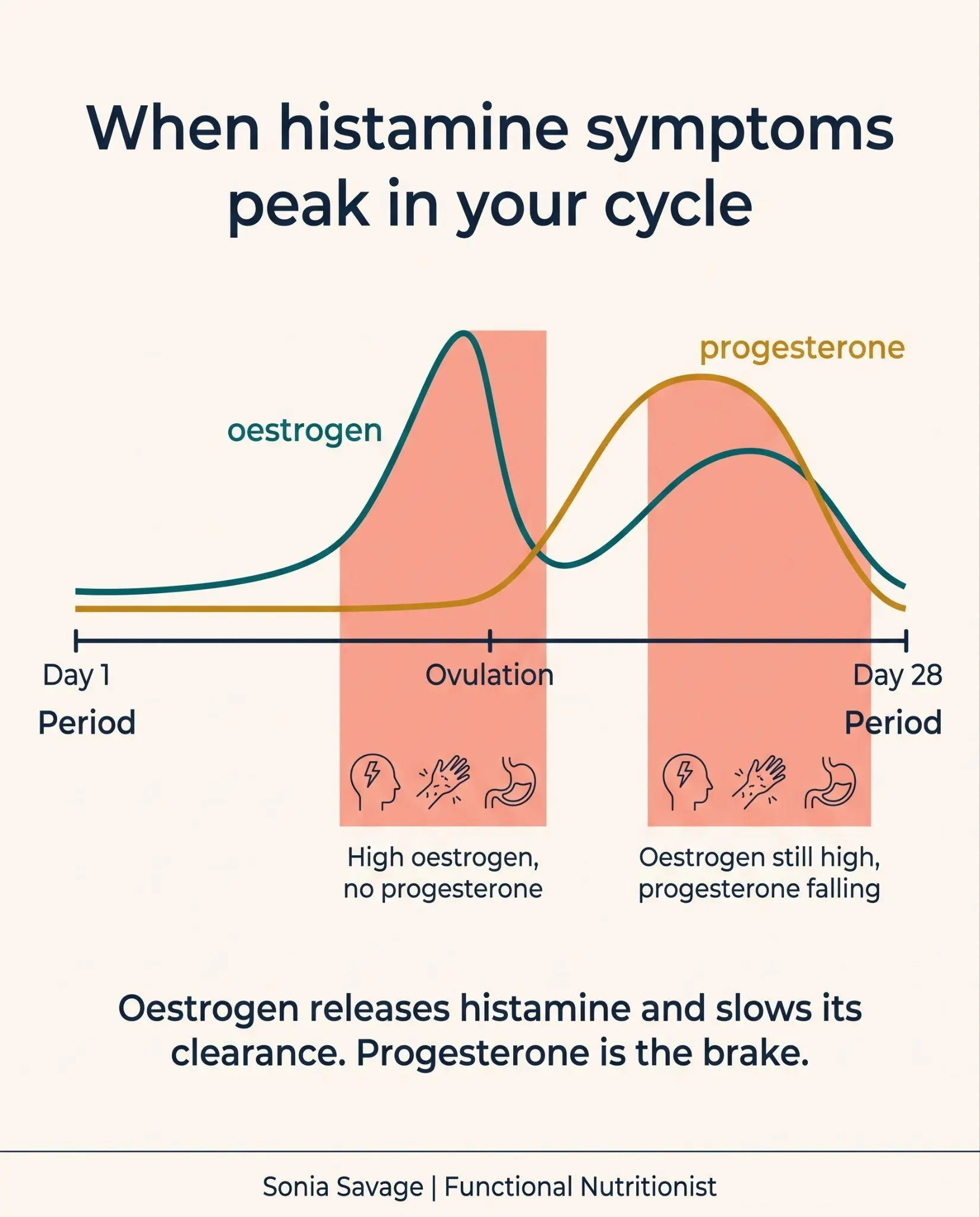
Oestrogen rises to a peak around ovulation (roughly mid-cycle) and again in the second half of the cycle, while progesterone is absent at ovulation and drops away in the days before a period. Those are exactly the windows when histamine is highest and clearance is lowest, so symptoms cluster there.
If you chart your symptoms against your cycle, a pattern usually appears. Two windows stand out.
Around ovulation, oestrogen surges and progesterone has not yet arrived to balance it. Histamine is also part of the ovulation process itself. Many women notice migraines, hives, flushing or a sudden "reaction" to a food that was fine last week.
In the late luteal phase, the week or so before bleeding, oestrogen can still be relatively high while progesterone falls. With the brake off, histamine builds, and this is when the itchy skin, anxiety, insomnia, bloating, breast tenderness and period pain tend to arrive together.
For years I looked at those two windows as separate problems with separate causes. Understanding the oestrogen-histamine loop was the piece that tied them together, and it is now one of the first things I map with any woman whose symptoms track her cycle.
What are the signs of an oestrogen-histamine problem?
The tell-tale sign is timing: symptoms that reliably worsen around ovulation and premenstrually. Common ones include headaches or migraines, hives, itching, flushing, nasal congestion, bloating, heart palpitations, anxiety, insomnia, heavy or painful periods, and new reactions to wine, cheese, chocolate or other high-histamine foods.
Histamine acts on receptors throughout the body, which is why the symptom list looks scattered across skin, gut, brain, heart and hormones. Look for several of these, worse at the same points of your cycle:
Headaches or migraines that arrive around ovulation or before your period
Hives, itching, flushing, eczema flares or a rash after certain foods
A blocked or runny nose, or seasonal-allergy-type symptoms that are not seasonal
Bloating, reflux, nausea or loose stools, particularly after wine, cheese, cured meats, fermented foods, chocolate or leftovers
Heart palpitations, dizziness or a sudden racing heart
Anxiety, irritability, restlessness or insomnia in the second half of your cycle
Heavy, painful or clotty periods, breast tenderness and premenstrual mood changes
A shrinking list of "safe" foods, with reactions to things you used to enjoy
Not everyone with these symptoms has a histamine problem, and not every histamine problem is driven by oestrogen. But when the timing lines up with your cycle, the loop is worth investigating properly.
Why does this get worse in perimenopause?
In perimenopause, progesterone is often the first hormone to decline while oestrogen fluctuates, sometimes to higher-than-usual peaks. That creates a relatively oestrogen-dominant state with less histamine clearance, which is why women in their forties often develop histamine reactions, wine intolerance and cyclical headaches seemingly out of nowhere.
Many women arrive in my clinic saying, "I never used to react to anything, and now I react to everything." Perimenopause is very often the reason.
Progesterone tends to fall first, because ovulation becomes less regular, and no ovulation means no progesterone that cycle. Oestrogen, meanwhile, does not decline in a neat line. It swings, and in the early years of perimenopause it can spike higher than it did in your thirties. High oestrogen, low progesterone: that is the exact combination that pushes histamine up and clearance down.
Add in the other things that shift at this stage, poorer sleep, more stress, a gut that has changed after years of antibiotics or a stressful decade, and the histamine bucket fills faster than it empties. New alcohol intolerance, flushing, itchy skin, palpitations and 3 am waking are the result.
This is also why I never look at perimenopause as "just hormones". The hormones are one piece. Histamine, gut health, cortisol rhythm, nutrient status and inflammation are all in the mix, and everything is connected.
How does gut health drive histamine load?
Histamine comes from two places: food, and your own gut bacteria. Some gut microbes make histamine from the amino acid histidine, and gut overgrowths such as SIBO or Candida can add to the load or impair DAO, the histamine-clearing enzyme made in your gut lining. An irritated gut therefore raises histamine from both directions.
When we talk about histamine, most people think of food. Aged cheese, red wine, cured meats, fermented foods, tomatoes, spinach, avocado, chocolate and leftovers are all high in histamine or trigger its release. That matters, but it is only half the story.
Your gut makes histamine too. Certain bacteria carry an enzyme called histidine decarboxylase, which converts histidine from protein into histamine. If your microbiome has drifted towards these histamine-producing species, you are topping up the bucket every time you eat, regardless of what is on the plate.
Candida overgrowth adds another layer. It produces acetaldehyde, a by-product that impairs DAO activity, so clearance drops. Bacterial overgrowth in the small intestine (SIBO) and general dysbiosis do something similar through fermentation and inflammation of the gut lining, where DAO is made.
This is why, in my experience, a low-histamine diet alone rarely fixes the problem. If the gut produces histamine and fails to clear it, the diet can only manage the symptoms. Calming the gut and rebalancing the microbiome restore tolerance, which is why I so often start histamine work with the gut.
Symptoms That Track Your Cycle?
Migraines at ovulation, hives before your period, reactions to foods you used to love, and bloods that keep coming back "normal". This is one of the most common puzzles I work through with women every week, and it is a core part of my gut health, histamine and MCAS work. If you would like someone to look at the whole picture, an initial consultation is the place to start.
How do you know whether oestrogen and histamine are behind your symptoms?
Start by tracking symptoms against your cycle for two or three months; a consistent ovulation and premenstrual pattern is the strongest clue. From there, a thorough history, bloods reviewed against optimal ranges, and where it will change the plan, a DUTCH hormone test or a GI-MAP stool test, help confirm what is driving the loop.
The first tool is free: a simple symptom diary alongside your cycle. Note headaches, skin, gut, sleep, mood and any food reactions, and mark the day of your cycle. Two or three months usually makes the pattern obvious.
In clinic, I take a proper timeline. When did this start? After antibiotics, a gut infection, a mouldy house, a stressful season, coming off the pill, or with the first signs of perimenopause? That history often points to the driver before any test is ordered.
Where a result will genuinely change the plan, I use targeted testing. A DUTCH test shows not just your oestrogen and progesterone levels but how you are metabolising and clearing oestrogen across the cycle. A GI-MAP stool test shows whether your microbiome is skewed towards histamine producers, whether there are signs of SIBO or Candida, and how inflamed or permeable the gut lining is. I also review bloods against optimal ranges, including the nutrients that DAO depends on and thyroid markers, because thyroid and histamine issues often overlap.
One thing I will never do is hand you a heavier label than the evidence supports. Histamine intolerance is a load-and-clearance problem. Mast cell activation syndrome (MCAS), where the mast cells themselves are unstable, is different and much less common. This would be diagnosed by a physician. The distinction matters, and a careful history usually makes it clear.
How do you support oestrogen clearance with food?
Your liver processes oestrogen in stages and your gut then removes it. Cruciferous vegetables, especially broccoli and broccoli sprouts, supply sulforaphane, which supports the liver pathways that favour a gentler form of oestrogen. Fibre, adequate protein and a healthy microbiome help the body excrete oestrogen rather than reabsorb it.
The body does not simply switch oestrogen off. It has to be processed by the liver, in phases, and then removed through the gut. If either step is sluggish, oestrogen recirculates and the loop keeps turning.
Food is your most powerful lever here. Cruciferous vegetables are rich in glucoraphanin, which converts to sulforaphane when the vegetable is chopped or chewed. Sulforaphane supports the liver's detoxification pathways and encourages the body to favour the gentler 2-hydroxy form of oestrogen over more troublesome forms.
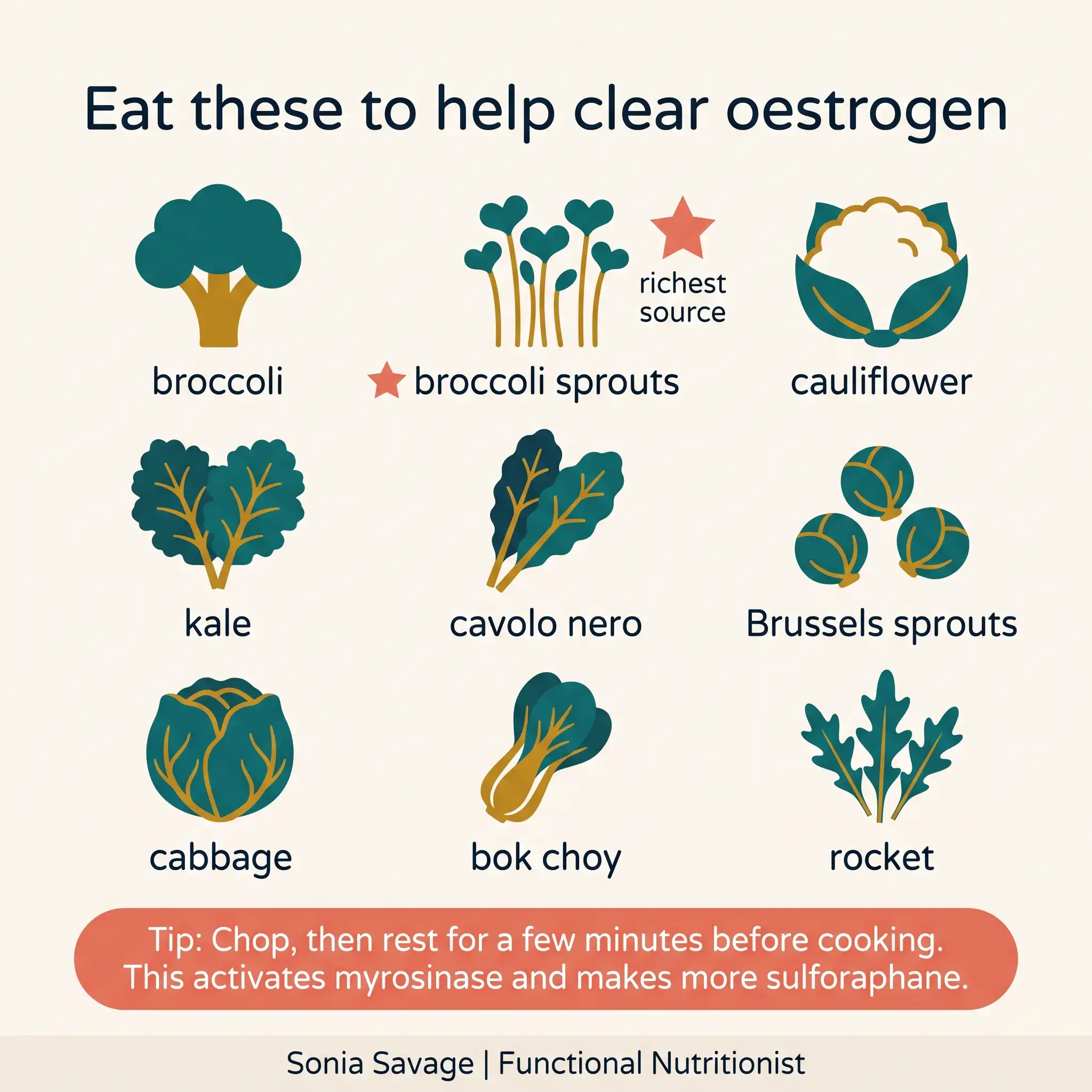
The best sources are broccoli and broccoli sprouts (the sprouts are by far the richest), cauliflower, kale, cavolo nero, Brussels sprouts, cabbage, bok choy and rocket. Aim for a serve or two most days.
A practical tip from clinic: chop your cruciferous vegetables and let them sit for a few minutes before cooking. This lets the enzyme myrosinase do its work and produces more sulforaphane. Lightly steaming rather than boiling helps too.
Beyond the crucifers, plenty of fibre from vegetables, legumes, nuts and seeds feeds a healthy microbiome and binds oestrogen in the gut so it leaves the body rather than being reabsorbed. This is the anti-inflammatory, mostly wholefood way of eating I use every day in clinic, and it is laid out step by step in my free Anti-Inflammatory Diet Starter Guide.
Should you follow a low-histamine diet?
A low-histamine diet is a short-term therapeutic tool, not a permanent way of eating. Used for a defined period, and especially through the ovulation and premenstrual windows, it lowers the load while you address the real drivers. The long-term goal is always the widest, most enjoyable diet you can tolerate.
Yes, sometimes, and with a clear end date.
Reducing high-histamine and histamine-releasing foods for a few weeks can bring real relief, and it tells us something: if you feel markedly better, histamine load is clearly part of your picture. Some women do well focusing the stricter version on the two symptom windows of their cycle, ovulation and the premenstrual week, and eating more freely at other times.
But I want to be honest about the limits. Restriction does not restore tolerance. I have seen too many women arrive with a list of five safe foods, still reacting, because nobody addressed the gut and hormone drivers underneath. Your list of safe foods should be growing, not shrinking. Diversity, not restriction, is the destination.
So in my practice a low-histamine approach is always individualised, always time-limited, and always paired with the work that lets us bring foods back in.
What about supplements and herbs?
Targeted nutrients, herbs and compounds can help by supporting histamine clearance, calming mast cells, supporting liver processing of oestrogen and encouraging healthy progesterone in the second half of the cycle. They should be individualised and prescribed on the back of your history and testing, not bought off a list.
There is a well-researched toolkit here, and I use it in clinic every week. Broadly, it covers four jobs: supporting DAO and the nutrients it depends on, steadying mast cells so they release less histamine, supporting the liver and gut pathways that process and remove oestrogen, and supporting progesterone in the luteal phase so the calming counterweight is there when you need it.
What I will not do is publish a shopping list. The right combination for a woman in her thirties with endometriosis and a Candida overgrowth is different from the right one for a woman in perimenopause with SIBO and low iron, and some of these compounds are the wrong choice alongside certain medications or thyroid and autoimmune conditions. This is exactly why I prescribe after I have seen your history, bloods and, where relevant, your genetics, and dispense through a practitioner-only dispensary so the form and dose are right.
Supplements are the top layer of the plan, not the foundation. Food, gut and lifestyle do the heavy lifting.
How do stress, sleep and your environment feed the loop?
Chronic stress, poor sleep and inactivity disrupt your stress hormone rhythm, slow liver detoxification and increase inflammation, all of which worsen both oestrogen dominance and histamine reactivity. Reducing xenoestrogens from plastics, fragrances and some cosmetics lowers the oestrogen load from outside the body.
The oestrogen-histamine loop does not run in isolation. It sits inside your nervous system and your environment.
Stress is a big one. A disrupted cortisol rhythm makes mast cells more reactive and slows the liver's clearance work. Poor sleep does the same, and histamine itself is a wakefulness chemical, which is why high-histamine nights so often mean wide-awake-at-3-am nights. The two problems feed each other.
Then there are xenoestrogens: chemicals in soft plastics, synthetic fragrances, some cosmetics and pesticides that mimic oestrogen in the body. They add to the oestrogen load your liver has to process. Swapping plastic food containers for glass, choosing fragrance-free products and washing produce well are simple, sustainable changes.
None of this needs to be done overnight. Gentle, gradual changes that you can keep are worth far more than a perfect week followed by burnout.
What does the plan look like, put together?
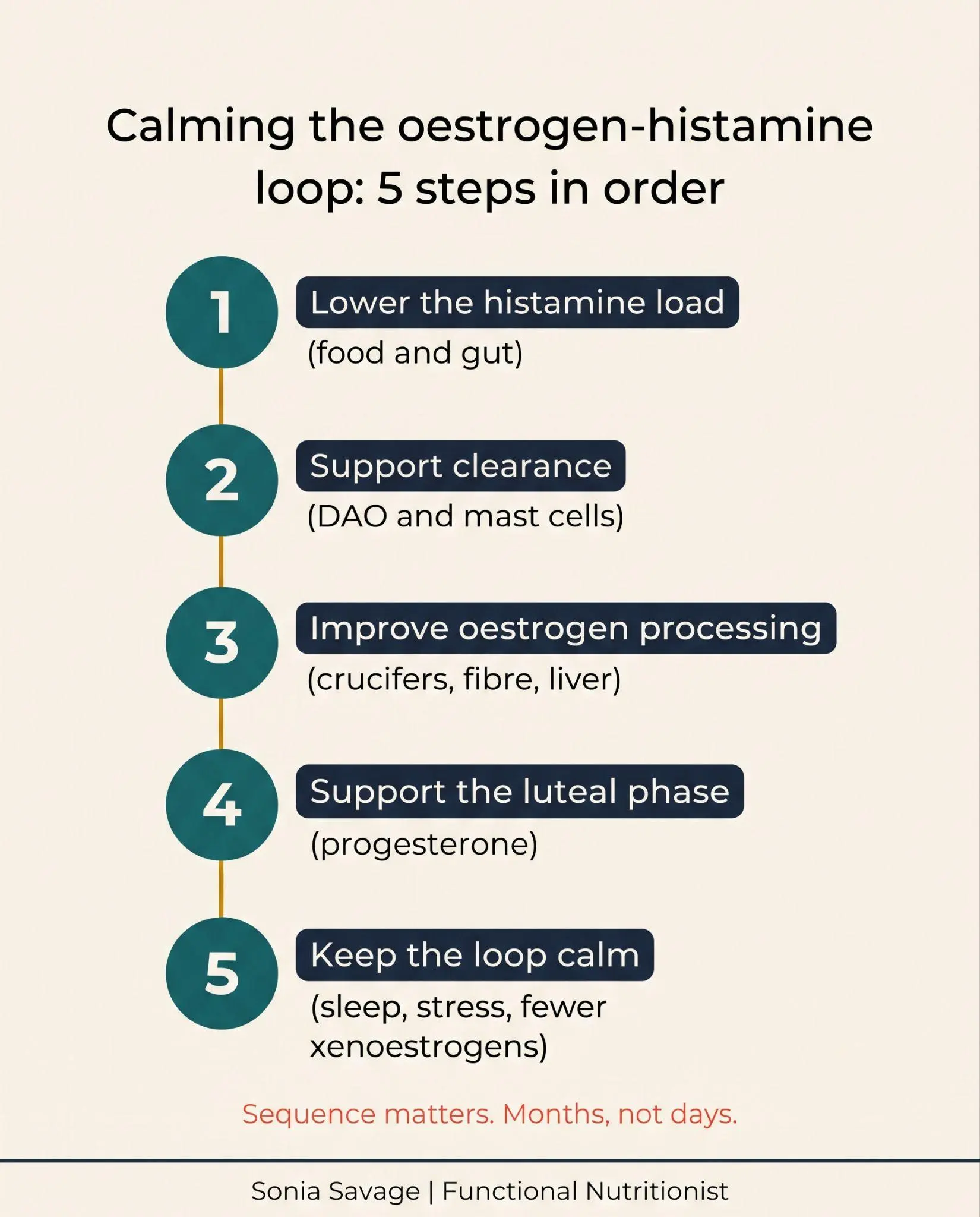
A five-part approach: lower the histamine load, support clearance, improve oestrogen processing, support the luteal phase, and build a lifestyle that keeps the loop calm. Done in the right order, over months rather than days, this is how most women I work with get their cycle back.
Here is the framework I work through with clients. It is sequenced deliberately, because the order matters:
Lower the histamine load. A time-limited, individualised low-histamine approach, plus addressing dysbiosis, SIBO or Candida so your gut stops manufacturing histamine of its own.
Support clearance. Restore the nutrients DAO depends on, calm the gut lining where DAO is made, and steady the mast cells so less histamine is released in the first place.
Improve oestrogen processing. Cruciferous vegetables daily, fibre for a healthy microbiome, and targeted liver and gut support where your testing shows it is needed.
Support the luteal phase. Encourage healthy progesterone in the second half of your cycle so the natural brake on histamine is there when you need it most.
Build a lifestyle that keeps the loop calm. Consistent sleep, movement that suits your capacity, stress regulation, and reducing xenoestrogens at home.
This week, start with the two things you can do without any testing: begin a cycle and symptom diary, and put a serve of chopped-and-rested cruciferous vegetables on your plate every day. Small steps, done consistently, are how this changes.
The reframe: your cycle is giving you information
So many women come to me exhausted, in pain, and quietly rearranging their lives around their cycle. Most have been told it is normal, or that it is in their head. It is neither.
Once you understand how oestrogen and histamine drive each other, and how your gut, liver, stress and environment feed in, your symptoms stop being a mystery. They become a map. And with the right support, in the right order, I have seen that map lead many women back to a cycle that no longer runs their life.
Frequently asked questions
Can a functional nutritionist help with histamine intolerance and hormone symptoms?
Yes. The oestrogen-histamine connection is core territory for my practice. In an initial consultation I take a thorough history and cycle timeline, review your bloods against optimal ranges, and where it will change the plan, use a DUTCH hormone test or GI-MAP stool test to find what is driving the loop. You leave with a clear, staged plan across food, gut, hormones and lifestyle. You can book online, or get in touch to arrange a free 15-minute call first.
Is it histamine intolerance or MCAS?
They are not the same. Histamine intolerance is an imbalance between the histamine coming in and your capacity to clear it, and it responds well to lowering load and restoring clearance. MCAS is a more complex condition in which mast cells release their contents inappropriately, and it is much less common. A careful history and symptom pattern usually makes the difference clear, and I will never give you a heavier label than the evidence supports.
Why do I get a migraine every month around ovulation?
Oestrogen peaks at ovulation and prompts histamine release while slowing its clearance, and histamine is a known migraine trigger. Progesterone, which would normally calm the response, has not yet risen. Reducing histamine load in the days around ovulation, supporting clearance and improving oestrogen processing are the first things I look at for cyclical migraines.
Why have I suddenly started reacting to wine and cheese in my forties?
Wine and aged cheese are high in histamine, and perimenopause is often the trigger. As progesterone falls first and oestrogen swings, histamine clearance drops and your bucket fills faster. It is rarely a new allergy; it is a load-and-clearance problem, and it is usually improvable once the gut and hormone drivers are addressed.
Will I have to follow a low-histamine diet forever?
No. In my practice a low-histamine diet is a short-term tool with an end date, used to lower the load while we address the drivers underneath. The aim is always to expand your diet again. If your list of safe foods keeps shrinking, that is a sign the real cause has not been found yet.
Which foods help clear oestrogen?
Cruciferous vegetables are the standouts: broccoli and broccoli sprouts, cauliflower, kale, cavolo nero, Brussels sprouts, cabbage, bok choy and rocket. Chop them and rest them for a few minutes before cooking to maximise sulforaphane. Plenty of fibre from vegetables, legumes, nuts and seeds helps the gut remove oestrogen rather than reabsorb it.
How long does it take to see a change?
Many women notice a difference within one to two cycles once histamine load drops and the gut is being supported. Deeper changes, such as fewer migraines, calmer skin and easier periods, tend to build over three to six months as the gut and hormone drivers are addressed. Every woman is different, and I will always be honest with you about timeframes.
Ready to work out what is really driving your cycle?
If you are tired of rearranging your life around your symptoms and would like someone to look at all the angles, I would love to help.
Book a Gut Health Consultation
A comprehensive deep dive into your history, cycle, symptoms and bloods, with a clear, staged plan. Online worldwide, or in person on Sydney's Northern Beaches. You will receive a confirmation with your health history form so I can review your story before we meet.
Not Sure Yet? Arrange a Free 15-Minute Call
Ask a few questions and see whether we are the right fit before you commit to a full consultation.
Free Download: The Anti-Inflammatory Diet Starter Guide
The way of eating I use every day in clinic, and the foundation of the gut and oestrogen-clearance work described in this article.
I look forward to working with you. Thank you for trusting me with your story.
Sonia Savage, Functional Nutritionist, Sydney. BHSc (Complementary Medicine, with Distinction), AdvDip (Nutritional Medicine), Registered Clinical Nutritionist, ATMS.
Sonia Savage is a Functional Nutritionist based in Sydney, consulting online Australia-wide and worldwide. With nine years of clinical experience, including senior clinical work in nutrigenomics at MTHFR Support, she specialises in fertility and preconception care, autoimmune and thyroid conditions, gut health and histamine issues, hormones and perimenopause, and children's wellness. Sonia has been a guest expert on the Designs for Health Wellness by Designs podcast and mentors other practitioners on complex cases. Her approach: everything is connected, and getting to the root cause beats chasing symptoms every time.