When Should You Start Preconception Nutrition, and What Should Both Partners Do?

Brief overview
Start preconception nutrition at least three months before you begin trying, and ideally six. That window matters because sperm take around three months to develop, and eggs go through their final stage of maturing over a similar period. Both partners count: half your baby's DNA comes from each of you, yet the male side is often overlooked. The essentials are a nourishing, anti-inflammatory way of eating, the right folate and iodine for her, zinc, selenium and antioxidants for him, less alcohol and no smoking or vaping, and blood tests read against optimal ranges for both of you.
A couple sat down in my clinic last year. She had a spreadsheet: every supplement, every blood test, every app that tracked her cycle. He had brought a coffee.
When I asked him when he last had a blood test, he laughed and said, "Am I meant to have one?"
Half your baby's DNA comes from him. So why is she the only one focusing on health? I see this pattern every week, and it is not anyone's fault. Most couples are simply never told that preparing for pregnancy is a job for two.
Here is what I wish every couple knew before they started trying: when to begin, what each of you can do, and which tests are actually worth asking for.
What is preconception nutrition, and why does it matter?
Preconception nutrition is the work both partners do with food, lifestyle and targeted support in the months before trying to conceive. It matters because the egg and sperm that make your baby are developing during that time, and they are shaped by the environment your bodies provide.
Most pregnancy advice starts at the positive test. By then, the egg and sperm have already done their growing. Preconception care moves the starting line earlier, to the stage where you still have time to make a difference.
In my fertility and preconception work, I focus on how the body's systems work together. Blood sugar, thyroid, gut health, inflammation, nutrient status and stress all influence hormone balance and egg and sperm health. By identifying and supporting the drivers that are out of balance, we give both of you the strongest possible foundation.
There is a bigger picture too. The nutrients and signals your bodies provide around conception play a role in how genes are switched on and off in early development. That is why I care about this window so much: it is about your future child's health, not only about falling pregnant.
When should you start preconception care?
Aim to start at least three months before you begin trying, and ideally six. The 90 days before you conceive matter more than most couples are ever told, because that is roughly how long sperm take to develop and how long an egg spends in its final stage of maturing.
Three months is the minimum I suggest, because it lines up with egg and sperm development cycles. Six months gives you time to run tests, get results back, and make changes before the most important 90 days begin.
Where autoimmunity, thyroid issues or significant imbalances are involved, I usually suggest four to six months or more of focused work. Settling inflammation before conception is a big part of how I support clients with thyroid and autoimmune conditions.
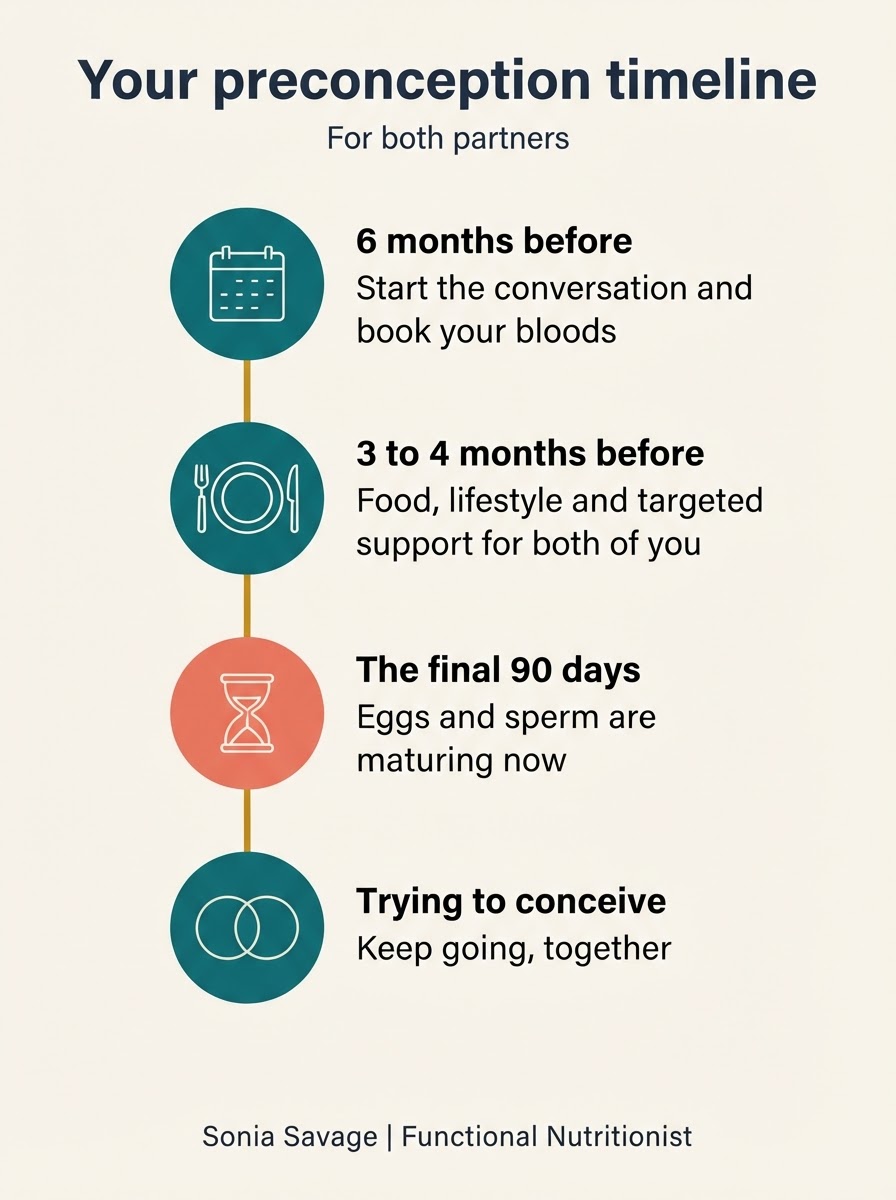
A simple way to picture it:
6 months before: Start the conversation and book your bloods.
3 to 4 months before: Food, lifestyle and targeted support for both of you.
The final 90 days: Eggs and sperm are maturing now.
Trying to conceive: Keep going, together.
If you are already trying, or already in an IVF cycle, it is not too late. We simply start from where you are.
Why does the male partner's health matter just as much?
Half of your baby's genetic material comes from the sperm, and sperm quality is shaped by his nutrition, lifestyle and health over the months before conception. Yet male health is very often under-investigated, which means a big part of the picture can be missed.
This is the missing half of fertility. In clinic I regularly meet couples who have been through rounds of testing and treatment where she has had every test going and he has had none, or only a basic semen analysis.
Sperm are made continuously, and it takes around three months for new sperm to fully develop. That means eating, drinking, sleeping and stress management over the next three months all influence the sperm that may one day become half of your baby.
For him, I look at:
Blood tests, including nutrient status, blood sugar, thyroid and inflammation markers.
A semen analysis, reviewed in detail rather than just marked normal or abnormal, including a DNA fragmentation test if it is in the budget.
Medications, past illnesses and any undiagnosed conditions.
Heat exposure, alcohol, smoking, vaping and work exposures.
If your partner cannot come to the first appointment, we can still begin, and I will guide you on the key tests worth arranging for him. I go deeper on this in Male fertility: the missing half.
What should both partners eat before trying to conceive?
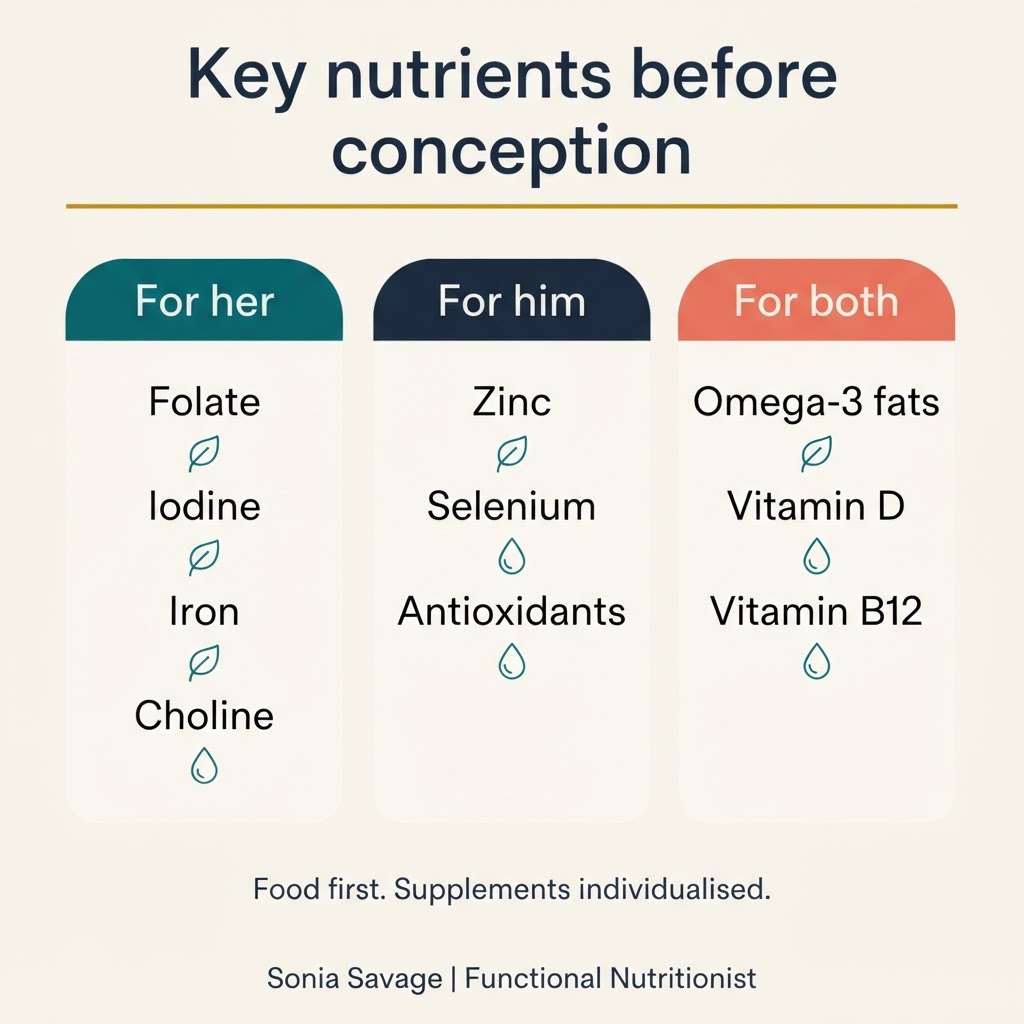
Both partners do best on a nourishing, anti-inflammatory way of eating built around protein, plenty of colourful vegetables, healthy fats and slow carbohydrates. On top of that foundation, a few nutrients deserve extra attention for her, for him and for both of you.
I do not hand out generic fertility meal plans, and you do not need exotic superfoods. You need a plate that keeps blood sugar steady, supports hormone production and gives your body the building blocks for healthy eggs and sperm.
Build the plate for both of you
Protein at every meal: eggs, fish, chicken, lamb, legumes, Greek yoghurt or tofu.
Half the plate as colourful vegetables, plus a couple of serves of fruit a day.
Healthy fats: extra virgin olive oil, avocado, nuts, seeds and oily fish such as salmon and sardines.
Slow carbohydrates in sensible portions: legumes, sweet potato, oats, quinoa and wholegrains.
Fewer ultra-processed foods, sugary drinks and refined snacks.
This is the Mediterranean-style, anti-inflammatory approach I use every day in clinic, and my free Anti-Inflammatory Diet Starter Guide walks you through it.
Key nutrients for her
Folate, iodine, iron, choline, vitamin B12 and vitamin D are the ones I check first. Folate and iodine are recommended in Australian guidelines for women planning a pregnancy, and the right form of folate matters for every woman, which is where nutrigenomics comes in. B12 works alongside folate, so I check both together. Iron stores are often low before pregnancy, vitamin D is commonly insufficient, and choline is easy to miss if you do not eat eggs.
Key nutrients for him
Zinc, selenium, B12, folate, vitamin D and antioxidants play a role in normal sperm production and in protecting sperm from oxidative stress. Seafood, eggs, meat, nuts, seeds, legumes, leafy greens and colourful fruit and vegetables are great food sources. Two Brazil nuts a day is a simple selenium-rich habit many men find easy to keep.
Key nutrients for both of you
Omega-3 fats, vitamin D and vitamin B12 matter for both partners. Oily fish twice a week, sensible time outdoors and enough animal foods or a well-planned alternative cover a lot of ground.
Preparing for pregnancy and not sure where to start?
This is exactly the work I do with couples every week: a thorough look at both of you, the right tests, and a clear plan for the months before you try. An initial consultation is the place to begin, for each partner.
Book an Initial ConsultationWhat lifestyle changes help both partners?
Stop smoking and vaping, cut right back on alcohol, protect your sleep, move regularly and limit exposure to hormone-disrupting chemicals. For him, keeping heat away from the testes matters too, because this three-month window is when these changes count most.
Smoking, vaping and recreational drugs: stop at least three months before trying, both of you.
Alcohol: keep it to a few drinks a week at most (for both of you) while preparing, and none once pregnant.
Sleep: a regular bedtime and seven or more hours supports hormone balance for both partners.
Movement: walking, strength training and yoga are great. Very intense training on top of a stressed system can work against you.
Heat for him: limit saunas, hot baths and laptops on the lap.
A lower-tox home: store food in glass or stainless steel, filter your drinking water, and choose simpler personal care and cleaning products.
You do not need to overhaul your whole life in a weekend. Pick one or two changes, make them a habit, then add the next.
Which tests are worth asking for before you conceive?
A thorough set of blood tests for both partners is the most useful place to start, read against optimal ranges rather than only the standard reference range. For him, add a semen analysis. Functional and genetic testing can follow, but only where the result will change the plan.
I only order a test if the result will change what we do. That keeps costs sensible and keeps the focus on what matters for your plan.
| Test | Why it matters | Who |
|---|---|---|
| Full blood count and iron studies | Iron stores and overall health | Both |
| Full thyroid panel, including antibodies | Thyroid function plays a key role in fertility and early pregnancy | Her, and him where indicated |
| Vitamin D, B12 and folate | Nutrients involved in egg, sperm and early development | Both |
| Zinc and copper | Zinc plays a role in normal egg and sperm health, and the balance with copper matters | Both |
| Homocysteine | A marker of methylation, the process folate is part of | Both |
| Blood sugar markers | Steady blood sugar supports hormone balance | Both |
| Semen analysis | Count, movement and shape of sperm | Him |
I also look at things that are frequently never checked, such as thyroid antibodies, which can be elevated even when thyroid hormones look normal. Where it will genuinely inform the plan, I may suggest functional or genetic testing, such as MTHFR, which affects how your body uses folate.
Your GP may be happy to help arrange your bloods. Alternatively, if working with me I can send you a pathology request (not covered by Medicare when ordered through me), or you can order panels yourself through Instant Scripts, from $25, or iScreen.
Do you need supplements before pregnancy?
Supplements are best chosen with guidance, and ideally started a minimum of three months before conception. What you need depends on your test results, your history and your genetics, for both partners.
Supplements work best as part of a plan, not a one-size-fits-all product. The right nutrients, forms and doses vary from person to person, and some products leave out what you need or include what you do not.
He may need support too, which is something most couples have never considered. In clinic, I prescribe after looking at your bloods and history, and supplements are dispensed through a practitioner-only dispensary so you get the right form at the right dose. No guesswork, and no cupboard full of bottles you are not sure about.
When should you get extra support?
Working with a practitioner like me can help if you have been trying for a while without success, have had a miscarriage, have irregular or very painful periods, or have a known thyroid or autoimmune condition. I work alongside your GP or fertility specialist (if applicable), so you have support from both sides.
Reach out for support if:
You have been trying for 12 months without success, or for six months if she is 35 or older.
You have had one or more miscarriages.
Her cycles are irregular, very painful or very heavy.
Either of you has a thyroid, autoimmune or metabolic condition.
You are planning or already going through IVF.
I work alongside fertility specialists, IVF clinics and other health practitioners, not instead of them.
The short version
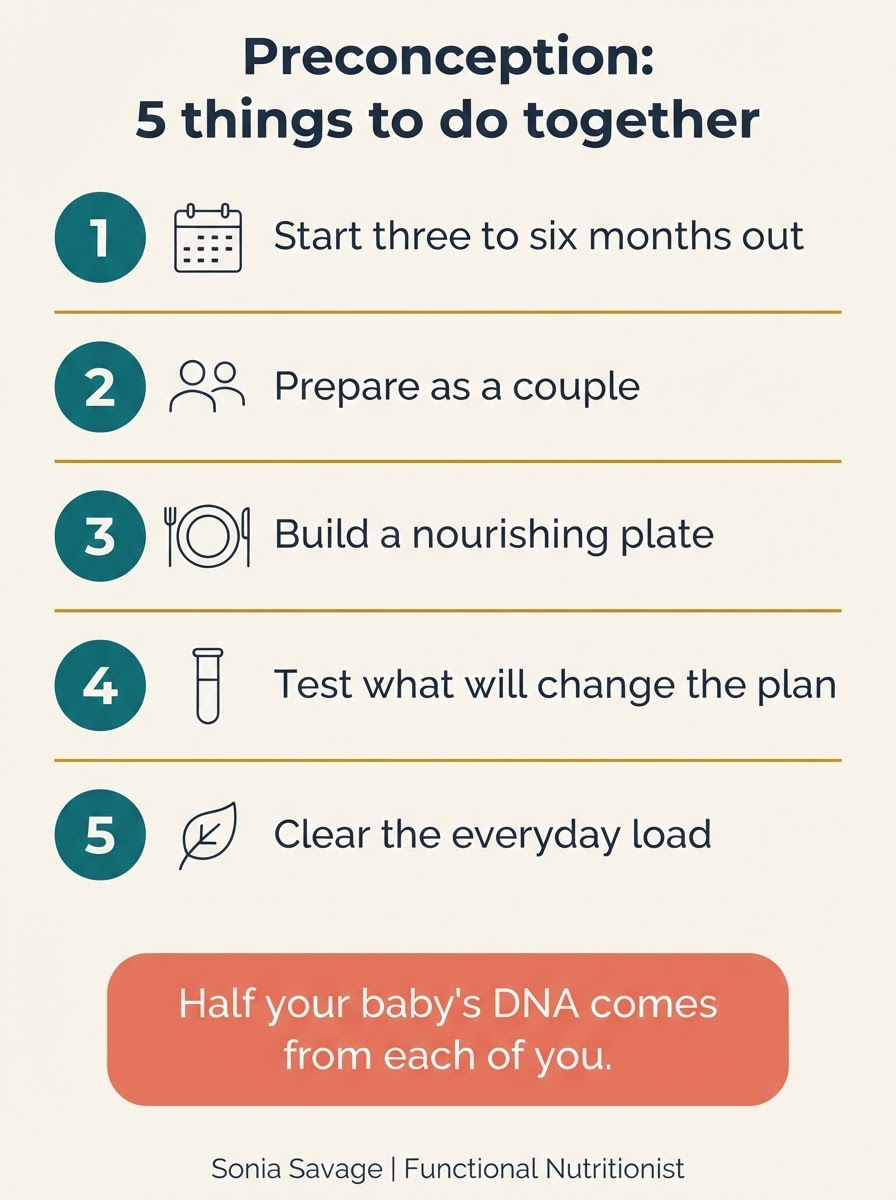
Start three to six months out. Sperm and eggs take around three months to develop.
Prepare as a couple. Half your baby's DNA comes from each of you.
Build a nourishing plate. Protein, colourful vegetables, healthy fats and slow carbohydrates, with key nutrients for each partner.
Test what will change the plan. Bloods for both of you, read against optimal ranges, plus a semen analysis for him.
Clear the everyday load. No smoking or vaping, less alcohol, better sleep and a lower-tox home.
Start this week
Sit down together and book both sets of bloods. Then add one shared habit, such as oily fish twice a week or a 20-minute walk after dinner. Small steps, done together, are what carry you through the next three months.
Frequently asked questions
Can a functional nutritionist help with preconception and fertility?
Yes. Preconception care for both partners is core to my practice. In an initial consultation for each partner, I take a thorough history, review your bloods against optimal ranges and recommend only the tests that will change the plan. You leave with a clear, staged roadmap for food, lifestyle and targeted support. You can book online, or get in touch to arrange a free 15-minute call if you have questions first.
How long before trying to conceive should we start preconception care?
At least three months, and ideally six. That lines up with the roughly three months sperm take to develop and the final stage of egg maturation. If autoimmunity or thyroid issues are involved, four to six months or more is often worthwhile.
Does my partner really need to be involved?
Wherever possible, yes. Half of your baby's DNA comes from the sperm, and male health is often under-investigated. If he cannot come at first, we can still start, and I will guide you on the key tests worth arranging for him.
What tests should we have before trying to conceive?
Start with a thorough set of bloods for both partners: full blood count, iron studies, a full thyroid panel with antibodies, vitamin D, B12, folate, zinc, copper, homocysteine and blood sugar markers. Add a semen analysis for him. I review results against optimal ranges and only suggest further testing where it will change the plan.
Is it too late if we are already trying or doing IVF?
No. It is never too late to support your health. I work alongside IVF clinics and fertility specialists, and because changes in egg and sperm health take around three months to show, starting now still makes a difference for future cycles.
Is a prenatal vitamin enough on its own?
It is a reasonable start for her, but it is not a plan. The right form and dose of folate varies between women, many prenatals miss nutrients or include ones you do not need, and he may need support too. I individualise supplements based on your results.
Do you offer preconception consultations online?
Yes. I consult online Australia-wide and worldwide, and in person at my clinic in Fairlight on Sydney's Northern Beaches. Couples can attend together or separately.
Ready to prepare, together?
If you would like someone to look at both of you, and all the angles, I would love to help. Many of the couples I support stay with me through pregnancy and on into children's wellness.
For couples who want structured support over the full preparation window, my six-month Balanced Life Fertility Boost program works with both partners from first consult to conception. You can read more about how I work on my fertility and preconception page.
Book an Initial Consultation
A comprehensive deep dive into your health history, symptoms and bloods, with a clear, staged plan. Each partner has their own initial consultation. Online worldwide, or in person on Sydney's Northern Beaches.
Book an Initial ConsultationNot sure yet? Book a free 15-minute call
Ask a few questions and see whether we are the right fit before you commit to a full consultation.
Get in touch to arrange a free callFree guide: The Balanced Life Fertility Boost
My free guide for couples: the foods, lifestyle changes, low-tox swaps and blood tests I recommend to both partners before conception.
Get the free guideI look forward to working with you both.
Sonia
Sonia Savage, Functional Nutritionist, Northern Beaches, Sydney. BHSc (Complementary Medicine, with Distinction), AdvDip (Nutritional Medicine), Registered Clinical Nutritionist, ATMS.
The information in this article is general in nature and does not take into account your individual health needs or medical history. It is not a substitute for personalised advice from a qualified health professional.